

Introduction to payment concepts
Some concepts to understand the payment context within our solution
🤵 Customer types
Xpollens's partners are able to propose payment services to different kind of customers.
Individual
An individual is a physical person. The individual might resides in the Schengen Area.
Individual Entrepreneur
The Individual Entrepreneur (EI) or Professional is a legal status that does not create a separate legal entity distinct from the entrepreneur. The entrepreneur operates in their own name, with no distinction between their person and their business.
Here are the key features:
- Single ownership → One person owns and operates the business;
- No share capital;
- No need to draft bylaws;
- Limited liability to professional assets;
- Tax regime: Personal Income Tax (IR), with the option to choose Corporate - Income Tax (IS);
- Social regime: Non-salaried worker.
- Individual entrepreneurs are recognized as natural persons (individuals) by the French regulator (ACPR).
Legal Entity
A legal entity is any company or organization that has legal rights and responsibilities. It is a business that can enter into contracts either as a vendor or a supplier and can sue or be sued in a court of law.
Xpollens can manage up to 40 nationalities of Legal Entity.
❓ KYC of a customer
A KYC (Know your Customer) should be made for all the physical person, individuals, professionals or responsible of a Legal Entity. Xpollens propose a full digital KYC solution which is eIDAS certified.
The eIDAS-Regulation oversees electronic identification and trust services for electronic transactions in the European Union's internal market.
It regulates electronic signatures, electronic transactions, involved bodies, and their embedding processes to provide a safe way for users to conduct business online like electronic funds transfer or transactions with public services.
Find here the EIDAS information of UE :
🔗 https://eur-lex.europa.eu/eli/reg/2024/1183/oj
📒 Account management
All the Xpollens payment accounts are associated with an IBAN. The IBAN can be from your own IBAN range (if you have your own banking license) or from Xpollens' range. For more information about using your banking license, please contact our sales team.
At Xpollens, we offer both individual and business accounts. Currently, all the accounts we provide are in euros only, although the solution is ready for multiple currencies. Other major European currencies will be available soon. For more details about our roadmap, feel free to contact us.
What is an IBAN ?
The IBAN (International Bank Account Number) is the unique identifier for a user Account. It uniquely identifies an individual account at a specific financial institution in a particular country. The IBAN follows the ISO 13616 international standard for numbering bank accounts. For more information on IBANs, you can visit the European Central Bank's website here : https://www.ecb.europa.eu/paym/integration/retail/sepa/iban/html/index.en.html
Once a user has been created, an account can be set up and assigned an IBAN.
IBAN definition
IBAN length can vary by country. For France, the IBAN is up to 27. Also, only some french overseas territories have IBAN with FR. You can also have these codes : GF, GP, MQ, RE, PF, TF, YT, NC, BL, MF(French part), PM and WF.
💳Cards management
Card program
If you are here it's because you want to launch a card program. To begin, we need to define your card product using the following criteria:
- Funding Source : Immediate Debit, Prepaid
- Target Audience: Consumer, Business, Corporate
- Product Type: Classic, Gold, Infinite
Next, we tailor the program based on the type of card you want :
- Card Type: Physical or Virtual
- Additional Options: Token (xPay), Wearable (keyring, bracelet, etc.)
Finally, we use our dedicated simulator to design the card, packaging, and card lifecycle.
Try our Card simultor here : 🔗Try our Card simulator
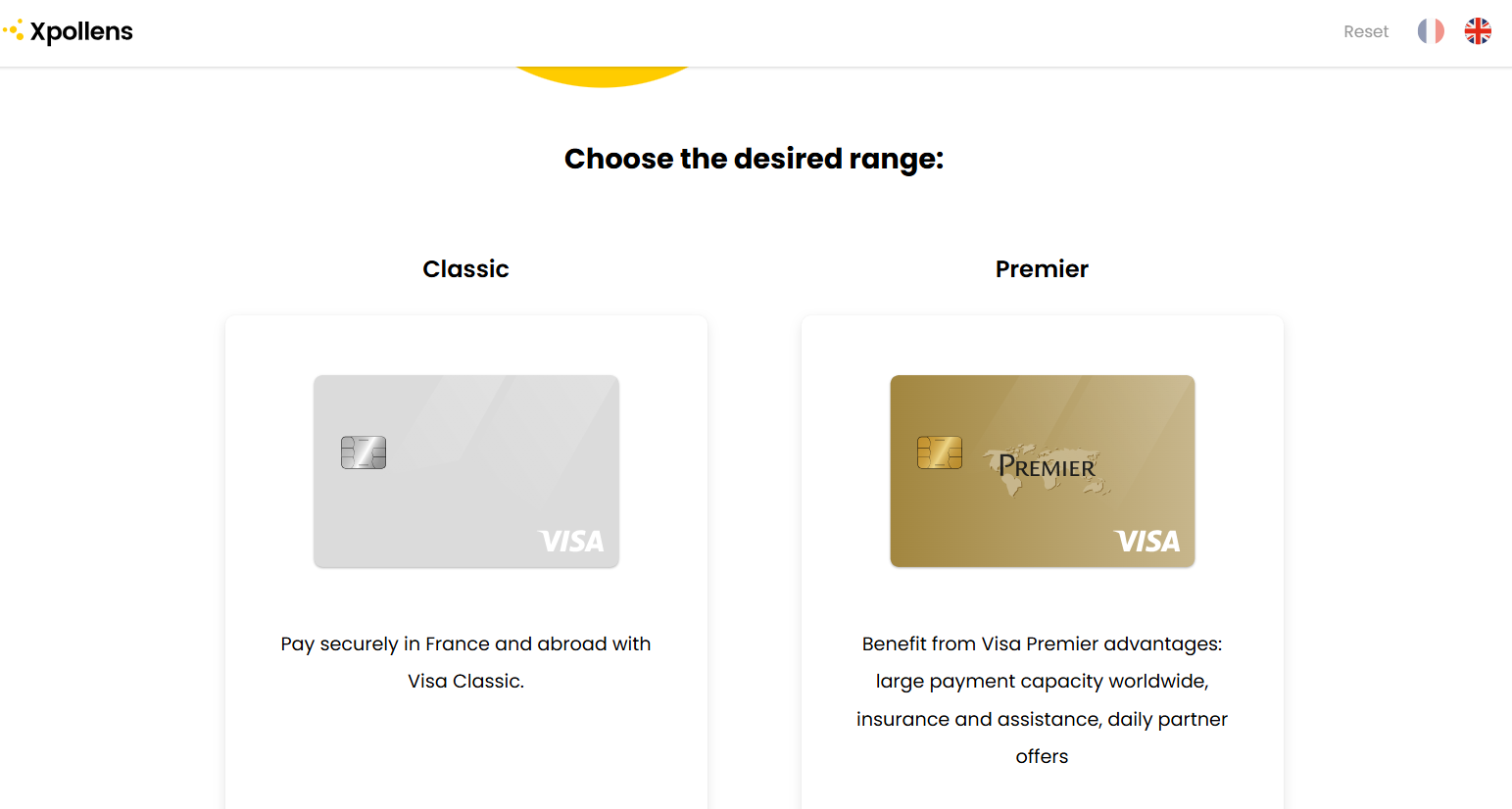
X-pay
What is X-Pay?
X-Pay enables your customers to make payments using their smartphones. They can enjoy fast and secure transactions in stores, apps, and online.
X-Pay providers
| X-Pay providers | Enrollment from X-Pay wallet (also known as In-App Verification) | Enrollment from partner app (also known as In-App Provisionning
or Push Provisionning) | Enrollment from partner Website (also known as Web Push Provisionning) |
| :-------------- | :--------------------------------------------------------------- | :-------------------------------------------------------------------------------------- | :--------------------------------------------------------------------- |
| Apple Pay | ✔️Supported | ✔️Supported | Delayed |
| Google Wallet | ✔️Supported | ✔️Supported | Delayed |
| Samsung Wallet | ✔️Supported | Not planned | Not planned |
Xpollens does not support other X-Pay providers such as Garmin Pay, FitBit Pay, Alipay, or WeChat Pay at the moment. However, we are working on integrating these services in the future.
Wallet enrollment flows
Two flows are employed for X-Pay enrollment:
Flow 1: Enrollment starts from the X-Pay wallet
This flow is also known as In-App Verification :
- Scan or enter card details
- Accept Terms & Conditions
- Strong authentication with the partner app
The last step is skipped if X-Pay provider trusts the end-user (Green path).
Flow 2: Enrollment starts from partner app
This flow is also known as In-App Provisionning or Push Provisionning.
- Open the partner app
- Go to the card management section
- Click on "Add to Apple Wallet", "Add to Google Wallet" or "Add to Samsung Wallet"
- Accept Terms & Conditions
Card payment lifecycle
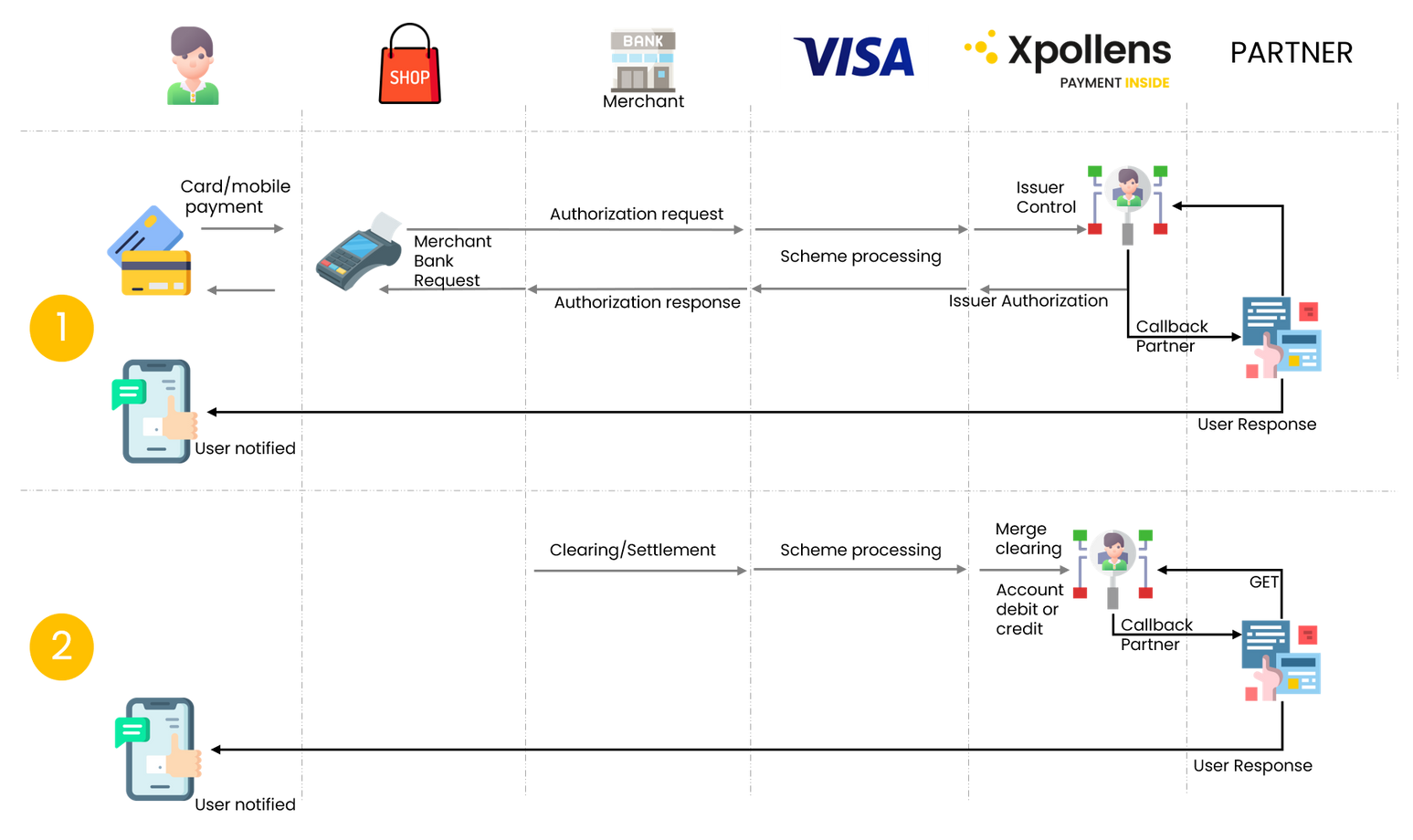
A cardholder can use their card or mobile device to pay a merchant (in-store, online, or at an automated terminal) or to withdraw cash.
Each transaction follows a two-step process:
Step 1-Authorization
In real time, the merchant’s Payment Service Provider (PSP) and its bank contact Xpollens’ Issuer Authorization Server (IAS) to request authorization. All issued cards are systematically authorized, meaning each transaction is evaluated before approval.
Xpollens checks multiple parameters to determine if the payment can proceed:
- PIN code validity
- Card activation status
- Available balance and spending limits
- Authorization of the country, payment type, or merchant (based on allowlists, blocklists, self-care settings, etc.)
- Other contextual or security rules
If approved, the transaction is authorized and the authorization balance is immediately updated to reserve the corresponding amount, ensuring the funds remain unavailable until the clearing phase.
Step 2-Clearing & Settlement
One or more days later, the merchant’s bank initiates the clearing process and sends a settlement request. Xpollens reconciles the authorization with the actual transaction details. The withheld funds are then debited from the user’s account, and the financial balance is updated on Xpollens’ side.
In some cases (e.g., fuel stations), the settled amount may differ from the authorized amount. Certain transactions may also be processed offline if specific conditions are met.
💶 SEPA Payment
SEPA zone
The SEPA region consists of 36 European countries, including several that are not part of the euro area or the European Union. It also includes all French overseas territories.
For more information, visit the European Central Bank's website:
🔗https://www.ecb.europa.eu/paym/integration/retail/sepa/html/index.en.html
Two protocols are used for money transfers within this system: SCT and Instant SCT. SCT stands for SEPA Credit Transfer and has been in use since the creation of the euro.
Instant SCT
Instant SCT is an enhanced version of the existing SCT, launched in 2018. It has a few limitations:
- Euro only
- Maximum transfer amount: 100 000 € (planned to be removed by the end of 2025)
- Execution time: 10 seconds maximum
- Immediate credit/debit
- Irrevocable
- No service interruption (operations can be processed every day, including weekends and holidays)
SEPA Direct Debit (SDD)
SEPA Direct Debit (SDD) is a pull-based payment scheme that allows a creditor to debit a debtor's bank account. Like other SEPA transfers, an SDD requires the IBAN (and occasionally the BIC) of both the sender's and recipient's bank accounts. However, it differs in that the recipient of the funds requests the money transfer from the sender.
SEPA Direct Debit is available only in euros and can be used for both one-off and recurring payments. It is often used for recurring payments to help customers avoid missing payments and incurring additional fees. The debtor must sign a valid SDD mandate to authorize the creditor to withdraw funds from their account. Additionally, there are rules governing SDDs, such as pre-notifications, refunds, and returns.
Xpollens provides a complete solution for creating mandates and managing SEPA Direct Debit (SDD).If you already have a SEPA Creditor ID (SCI), you can use it to direct debit your customers. If not, we can provide you with one within 48 hours.
There are two payment schemes under SDD:
- SEPA Direct Debit Core scheme: available to both businesses and retail customers.
- SEPA Direct Debit Business to Business (B2B) scheme: Available only to businesses.
For more information, visit the European Payments Council's website:
🔗https://www.europeanpaymentscouncil.eu/what-we-do/sepa-direct-debit
🏦Internal payment Transfers or P2P
What is a P2P transfer ?
A P2P (Peer to Peer) transfer allows money to be transferred from one customer to another within the same bank. This method bypasses the banking network since both customers have their accounts with the same institution.
Advantages of P2P transfers
Opting for a P2P transfer instead of a classic SEPA Credit Transfer (SCT) offers several benefits:
- The transfer is immediate, with no banking network delays.
- The transfer is free, as there are no banking network fees.
- The only requirement is that both the payer and the payee are registered on your platform.
👮Compliance by design
As an Electronic Money Institution regulated in France by the ACPR ( Regafi registration) and as a part of BPCE group(the second largest bank in France), Xpollens adheres to both French regulatory compliance rules and BPCE group directives.
We offer various standard solutions and can also implement specific projects or custom requirements for our clients. In all cases, our compliance processes are tailored to the solution/project and the risk profile of your activity, clients, partners, or third parties.
Below is an introduction to some of the different processes involved.
Strong Customer Authentication (SCA)
The Second Payment Services EU Directive (PSD2) requires that an authentication mechanism is required for your end-customers if you are on the Retail B2C market ; it is also required for all key individuals of your professional customers, if you are on the Corporates B2B market.
Strong Customer Authentication might occur in two situations :
- Online Card Payments
- Banking Sensitive Operations
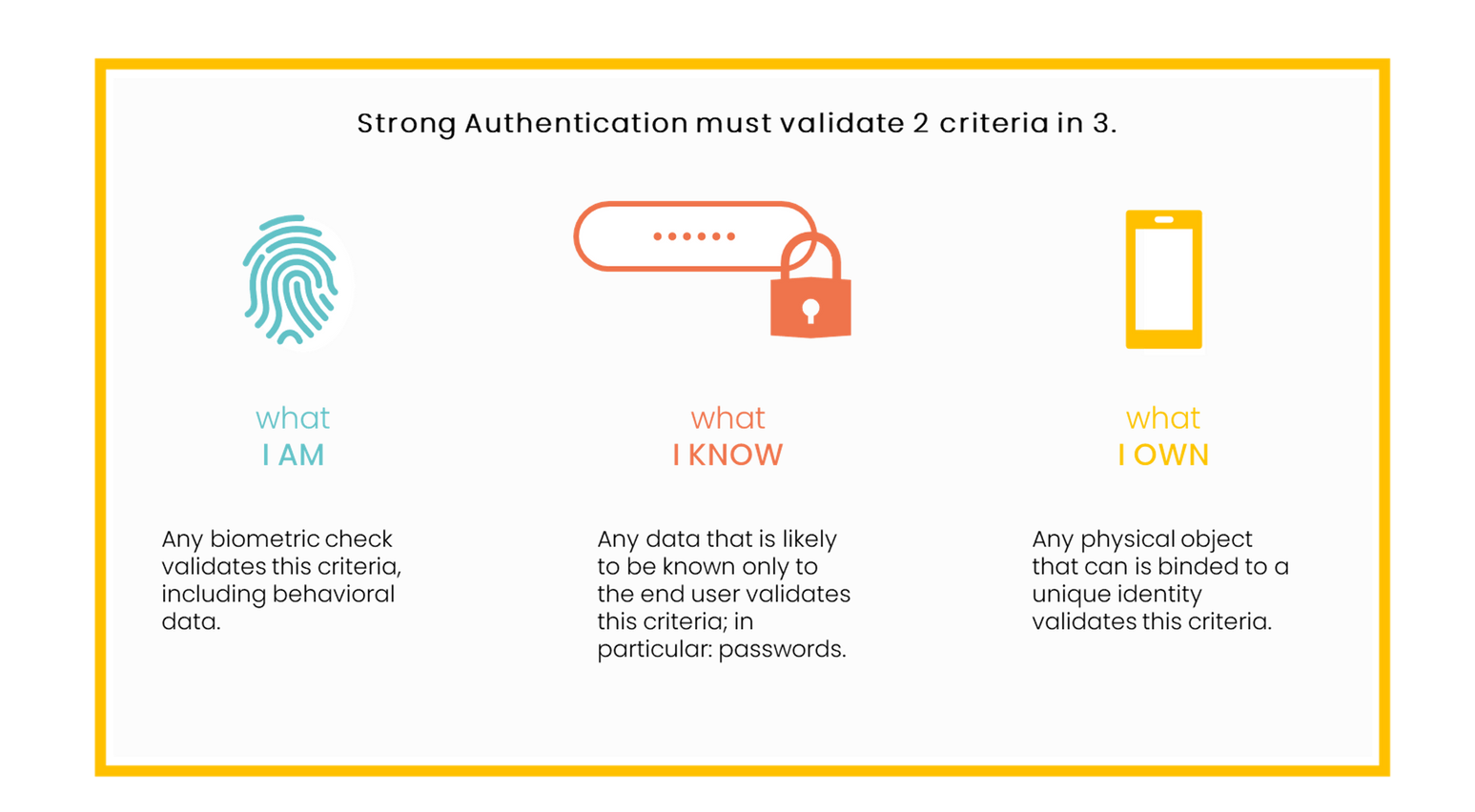
When the SCA mechanism happens, reuniting two criteras amongst three possible.
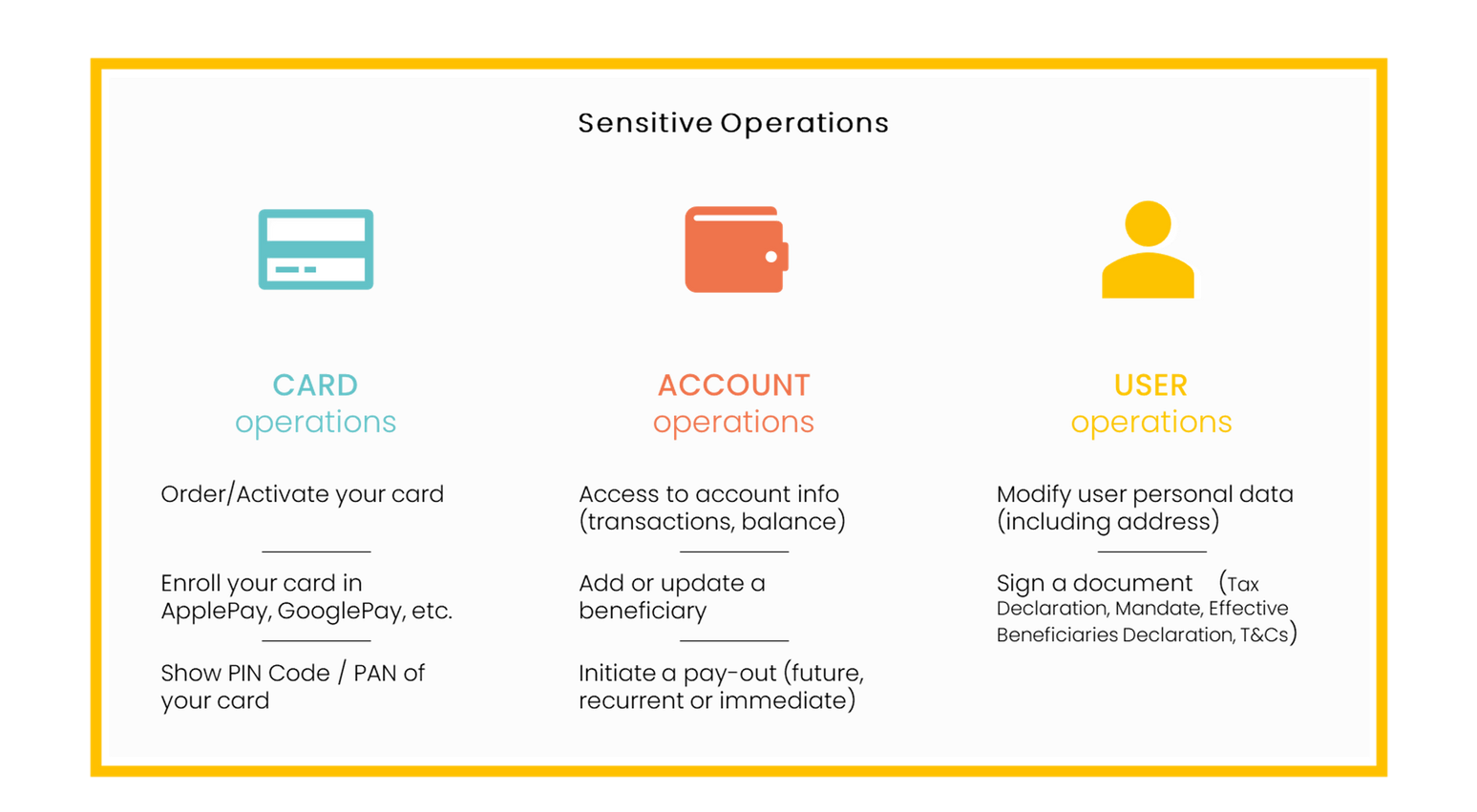
Here is a list of main Sensitive Operations. This is list is not exhaustive and may be subject to change.
Xpollens controls
Xpollens performs initial checks during customer onboarding and periodically throughout the customer contract. Identities are checked against international lists for both PEPs and sanctioned entities. Actions may include blocking the payment account or requesting additional information from the customer.
Customer Scoring
Xpollens calculates a score based on customer information. This affects payment activity controls and the interval between KYC updates.
Tax information control
To support governments in combating tax evasion, financial institutions must collect valid and credible self-certifications where customers declare their tax information.
Xpollens adheres to FATCA (Foreign Account Tax Compliance Act) and EAI/CRS (Common Reporting Standard) regulations, collecting tax information during onboarding and periodically or following specific events.
Retail and professional customers must provide their tax information and US relationship during onboarding.Customers can declare up to three tax countries and Tax Identification Numbers (TIN).
Business Process
Similar to retail and professional customers, businesses must provide tax information and US relationship details. The required information depends on the customer's activities. For financial businesses (banks, hedge funds, etc.), tax information related to business shareholders is also required. Up to three tax countries and TINs can be supplied.
Non-US business customers must provide accurate tax information consistent with their personal details and self-certification. For financial businesses, each shareholder (holding more than 25% of shares) must provide tax information, which will be included in the company's self-certification document.
AML/FT control
Xpollens screens and monitors operations to secure customers and combat money laundering and terrorism financing. For example, all incoming operations from sensitive geographies will be blocked, as well as outgoing operations to sensitive individuals.
Updated 8 months ago